

Social robots learning without us? New study cuts humans from early testing
作者:by University of Surrey
Humans no longer have exclusive control over training social robots to interact effectively, thanks to a new study from the University of Surrey and the University of Hamburg.
The study, presented at the IEEE International Conference on Robotics and Automation (ICRA), introduces a new simulation method that lets researchers test their social robots without needing human participants, making research faster and scalable.
Using a humanoid robot, the research team developed a dynamic scanpath prediction model to help the robot predict where a person would look in a social setting. The model was tested using two publicly available datasets, and the researchers demonstrated that humanoid robots were capable of mimicking human-like eye movements.
Dr. Di Fu, co-lead of the study and lecturer in cognitive neuroscience at the University of Surrey, said, "Our method allows us to test whether a robot is paying attention to the right things—just as a human would—without needing real-time human supervision. What's exciting is that the model remains accurate even in noisy, unpredictable environments, making it a promising tool for real-world applications like education, health care, and customer service."
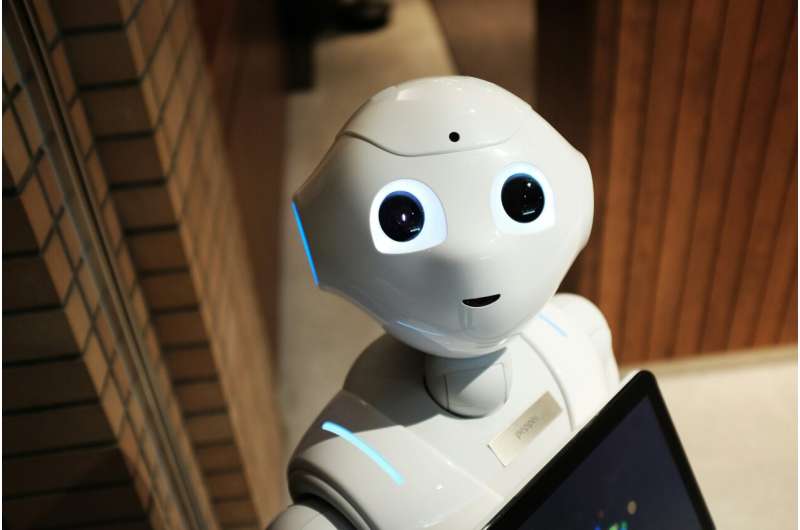
Social robots are designed to interact with people using speech, gestures, and expressions, making them useful in education, health care, and customer service. Examples of social robots also include Pepper, a retail assistant, and Paro, a therapeutic robot for dementia patients.
The research team matched how their model worked in the real world to that of a simulated one, projecting human gaze priority maps onto a screen to compare the robot's predicted attention focus with real-world data. This allowed for direct evaluation of social attention models in realistic conditions, reducing the need for large-scale human-robot interaction studies in the early phases of research.
Dr. Fu comments, "Using robotic simulations instead of early-stage human trials is a major step forward for social robotics. It means we can test and refine social interaction models at scale, making robots better at understanding and responding to people. Next, we want to apply this approach to areas like social awareness in robot embodiment and explore how it can work in more complex social settings and different types of robots."
Citation: Social robots learning without us? New study cuts humans from early testing (2025, May 19) retrieved 19 May 2025 from https://techxplore.com/news/2025-05-social-robots-humans-early.html
This document is subject to copyright. Apart from any fair dealing for the purpose of private study or research, no part may be reproduced without the written permission. The content is provided for information purposes only.
关于《Social robots learning without us? New study cuts humans from early testing》的评论
发表评论
摘要
相关讨论
- Global Neck Cream and Mask Sales Market Surges with Demand for Targeted Skincare Solutions and Anti-Aging Innovations
- 我有个刚会走路的孩子。她应该如何准备去应对15年后的人工智能的世界的职场?我应该在她肯学的时候就开始教她Python么?
- 新西兰不为人知的另一面:分享一个有关留学和移民失败的案例
- [上海] Wiredcraft 招聘Javascript CSS前端开发;Node.js Golang Python后端开发程序猿!还有QA Tester;DevOps;项目经理等职位等你来投!!
- Global Recycled Polyester Staple Fiber Market Booms Amid Growing Demand for Sustainable Textiles